Independent editorial reference · Galway, Ireland
Methods for working with public data, written down.
Open Data Desk documents how public records and datasets are found, cleaned, analysed, verified and published. Every page states its sources, its assumptions and the point at which the evidence stops. Free to read, with nothing to sell.
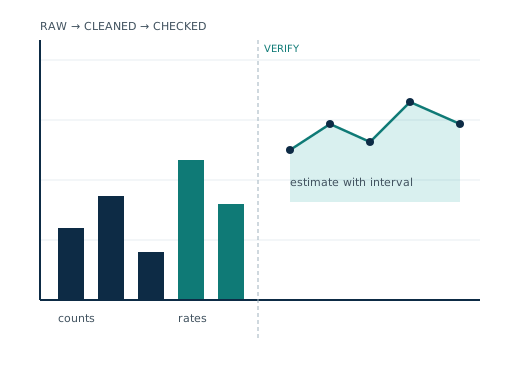
What this reference contains
The working steps, not the finished stories
Data journalism is usually described through its outputs: the map, the interactive, the leaked cache. The part that determines whether any of it holds is rarely written down — how a dataset's limits were established, what a blank cell was taken to mean, which denominator was chosen, who re-derived the headline figure before publication.
This site documents that layer. Each page defines its terms, describes a procedure that can be repeated, names the errors that occur when a step is skipped, and closes by stating what the available evidence cannot establish. Nothing here is a promise of a result, and nothing here is legal advice.
Sources
Where public records live, what they omit, and how to establish the limits of a file before analysing it.
Analysis
Cleaning, statistical reading, uncertainty and visualisation choices that do not overstate a finding.
Verification
Provenance, location and time, independent corroboration, and the documentation that makes a finding checkable.
Field pages
Ten areas of practice, one page each
Each field page follows the same shape: definition, procedure, recurring errors, a comparison table, a checklist and three questions. The repetition is deliberate — it makes gaps between fields visible.
-
Field 01
Open data portals
How public data portals are organised, how to read a dataset description honestly, and why the gaps matter more than the downloads.
-
Field 02
Cleaning data
The routine work that decides whether an analysis is sound: structure, types, duplicates, missing values and a record of every change made.
-
Field 03
Statistical literacy
Averages, rates, percentages, uncertainty and correlation: the small set of ideas that prevents most published numerical errors.
-
Field 04
Visualisation
Choosing a chart for the question, handling axes and colour honestly, and making a graphic readable for everyone.
-
Field 05
OSINT techniques
Working with publicly available material lawfully: provenance, corroboration, documentation and the boundaries that must not be crossed.
-
Field 06
Geolocation
Establishing where and when a photograph or video was made, using landmarks, shadows, weather records and independent imagery.
-
Field 07
Access to records
Writing a request that can be answered, understanding exemptions and fees, and treating a refusal as information rather than a dead end.
-
Field 08
Company registries
Reading filings, mapping ownership and control, and understanding what a register proves and what it merely records.
-
Field 09
Reproducibility
Organising an analysis so that another person can rebuild the number, and publishing enough for a reader to check it.
-
Field 10
Ethics and privacy
Proportionality, minimisation, security and harm assessment when an investigation involves data about identifiable people.
How material is prepared
From primary source to a stated limit
The procedure behind every page on this site is published in full and is meant to be reproducible by a reader working from the same sources.
- Define the objectWhat exactly is being described, for which population and over which period.
- Go to the primary sourceOfficial records, statistical documentation, legislation and peer-reviewed research rather than coverage of them.
- Separate record from inferenceWhat the documents establish is kept distinct from what they suggest.
- State the limitEvery page ends with the questions the available sources do not resolve.
Formats
Written to be consulted rather than read once
Long pieces with numbered sections, an internal index, a worked sequence and one arithmetic tool.
Focused descriptions of a single area of practice, with a comparison table and checks.
Plain definitions of the words that recur in data reporting, including the ones used loosely.
Verifiable steps to work through, not assurances about outcomes.
Open Data Desk runs no classes, courses, programmes, examinations or individual tuition, and issues no certificates of any kind.
Who it is for
For people who handle public records or check claims made from them
The material is written for adults who meet datasets, official statistics and open-source evidence in their work or in public argument and want a neutral starting point. It assumes no professional status, assesses no individual situation, and replaces neither professional training nor advice from a qualified lawyer or data-protection specialist.
Independence
Independence is a procedure, not a claim
No tool vendor, publisher, public body or campaign pays to be mentioned or treated favourably. There is no sponsored content, no affiliate linking, no paid placement and no service offered to any organisation described in this material.
Open access. Open Data Desk sells no courses, awards no qualifications, offers no consultancy and takes no payment from any tool vendor, publisher or public body described in its material.
Common questions
What this site is and is not
Is Open Data Desk a journalism school?
No. It is an open-access editorial reference. It runs no courses, enrols no students and awards no qualifications or certificates.
Does the material constitute legal advice?
No. Descriptions of access rights and data-protection duties are general information. A specific situation needs the legislation in force and a qualified professional.
Does the site teach ways around access controls?
No. It describes work with publicly available records only, within the law and the data-protection framework, and it states that boundary explicitly.
How is an error reported?
Through the details on the contact page, naming the page, the sentence disputed and a verifiable source.